
Soccer is more than just a game; it’s a strategic challenge that requires understanding various tactics. For beginners, grasping the basics of soccer tactics can greatly enhance their appreciation of the game. This article breaks down the essential elements of soccer tactics, making it easier for newcomers to understand how teams plan their plays both offensively and defensively.
Key Takeaways
- Soccer tactics are strategies used by teams to win games.
- Offensive tactics focus on scoring goals while defensive tactics aim to prevent the opponent from scoring.
- Understanding the four phases of play is crucial for effective team strategy.
- Different formations like 4-4-2 and 4-3-3 serve specific tactical purposes.
- Adapting tactics to fit team strengths and weaknesses is key for success.
Understanding Soccer Tactics
What Are Soccer Tactics?
Tactics in soccer refer to the strategies used by players and teams to achieve their goals during a match. They can be offensive or defensive, depending on whether the team has possession of the ball or not. The main aim of these tactics is to create pressure on the opponent, leading to mistakes that can be exploited.
Importance of Tactics in Soccer
Understanding tactics is crucial for success in soccer. Here are some key points:
- Enhances team performance: Good tactics can improve how a team plays together.
- Adapts to opponents: Teams can adjust their strategies based on the strengths and weaknesses of their rivals.
- Maximizes player skills: Effective tactics utilize the unique abilities of each player.
Basic Principles of Soccer Tactics
To grasp soccer tactics, consider these fundamental principles:
- Formation: The arrangement of players on the field.
- Movement: How players position themselves during play.
- Communication: The way players interact to execute strategies.
Tactics are not just about winning; they are about playing smart and making the most of every opportunity.
In summary, soccer tactics are essential for both individual players and teams. They help in creating a structured approach to the game, allowing teams to perform at their best. Understanding these tactics can lead to better gameplay and more victories.
Highlights
- Soccer Tactics: A complete guide to soccer positions, exploring the 10 most popular soccer formations, their strengths, and how top teams use them. Learn to choose the right formation for your team’s success.
Offensive Tactics in Soccer Explained
Game Structure as an Offensive Tactic
Offensive tactics in soccer focus on how a team organizes itself to score goals. The game structure is key to creating chances. Teams can choose to build up play either through the wings or the center. Here are the two main approaches:
- Wing Play: Utilizing the sides of the field to stretch the defense.
- Central Play: Focusing on the middle to create scoring opportunities.
Creating and Exploiting Scoring Opportunities
Once the game structure is set, the next step is to create and exploit scoring chances. This involves:
- Quick Passing: Moving the ball swiftly to confuse defenders.
- Player Movement: Making runs to open space and receive the ball.
- Counter-Attacking: Quickly transitioning from defense to offense after winning the ball.
In soccer, timing and teamwork are essential for creating effective scoring opportunities.
Examples of Offensive Soccer Tactics
Here are some common offensive tactics used in soccer:
- 1 vs. 1 Dribbling: Taking on a defender directly.
- Double Pass: A quick exchange of passes to bypass defenders.
- Through Balls: Passing the ball into space for a teammate to run onto.
By understanding these tactics, players can better position themselves to score goals and contribute to their team’s success. Remember, offensive tactics are all about teamwork and strategy!
Defensive Tactics in Soccer Explained

Understanding Defensive Tactics
Defensive tactics in soccer focus on how a team plays when the opponent has the ball. The main goal is to stop the other team from scoring. There are four main approaches to defensive tactics:
- Attack Pressing: This involves putting pressure on the opponent high up the field to win the ball back quickly.
- Midfield Pressing: Here, the team applies pressure in the midfield area, trying to cut off passing lanes.
- Defensive Pressing: This tactic focuses on defending deeper, allowing the opponent to have the ball but limiting their scoring chances.
- Deep Defense: In this approach, the team sits back and defends close to their goal, waiting for the right moment to counterattack.
Types of Defensive Pressing
Each type of pressing has its own strengths and weaknesses:
| Type of Pressing | Advantages | Disadvantages |
|---|---|---|
| Attack Pressing | Forces mistakes, creates quick scoring chances | Can leave gaps if the press fails |
| Midfield Pressing | Controls the center of the field | Requires high fitness levels |
| Defensive Pressing | Reduces space for the opponent | Can be too passive, inviting pressure |
| Deep Defense | Less running, can tire out the opponent | Very passive, relies on perfect counterattacks |
Examples of Defensive Soccer Tactics
To effectively defend, teams often use a mix of these tactics. For instance, a team might start with attack pressing but switch to deep defense if they are leading late in the game. Flexibility is key in adapting to the flow of the match.
Defensive tactics are crucial for a team’s success. They not only prevent goals but also create opportunities for counterattacks.
By understanding these defensive strategies, players can better position themselves and work together to protect their goal. The evolution of soccer tactics over decades has shown how important it is to be adaptable and smart on the field, especially when it comes to defense.
The Four Phases of Play in Soccer
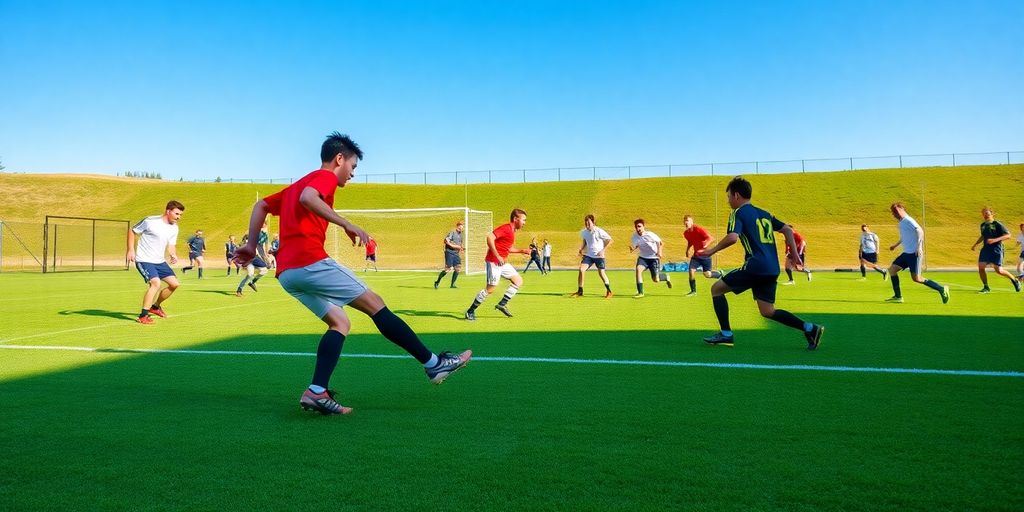
In soccer, understanding the different phases of play is crucial for both players and coaches. These phases help teams strategize effectively during a match. The game can be broken down into four main phases:
Playing Against the Ball
In this phase, the opposing team has possession of the ball. The main goal is to regain control. Here are some key points to consider:
- Positioning: Where should players position themselves to win the ball back?
- Pressing: Should the team press high up the field or fall back to defend?
- Communication: Players must communicate effectively to coordinate their efforts.
Playing With the Ball
When your team has the ball, the focus shifts to creating scoring opportunities. Important aspects include:
- Build-up Play: How will the team move the ball up the field?
- Spacing: Are players maintaining proper distance to avoid crowding?
- Decision Making: Players must decide whether to pass, dribble, or shoot.
Switching Offensive
This phase occurs immediately after winning the ball. Teams must quickly transition to attack. Consider:
- Immediate Action: Should the team push forward quickly or maintain possession?
- Options: Are there players in good positions to receive a pass?
- Surprise: Can the team catch the opponent off guard?
Switching Defensively
When possession is lost, the team must react swiftly to regain control. Key points include:
- Pressure: Should the team apply pressure immediately or regroup?
- Formation: How should players reorganize to defend effectively?
- Recovery: Are players aware of their roles in regaining possession?
Understanding these four phases can help players become better scouts by recognizing the flow of the game. Once you see it, you can never unsee it: when a player performs a football action, they go through four stages: collecting information, deciding what to do, and executing the action.
Popular Soccer Formations and Their Impact
In soccer, formations are crucial as they determine how a team plays on the field. Different formations can lead to different styles of play, affecting both offense and defense. Here are some popular formations:
The Classic 4-4-2 Formation
The 4-4-2 formation is one of the most traditional setups in soccer. It consists of four defenders, four midfielders, and two forwards. This formation is known for its balance between defense and attack.
Pros:
- Balanced structure, providing both defensive strength and offensive options.
- Simplifies player roles, making it easier for everyone to understand their tasks.
- Effective in wide areas, with wingers supporting both defense and attack.
Cons:
- Can struggle against teams using an extra midfielder.
- Less control in midfield against packed formations.
- May become predictable in attack.
The Modern 4-3-3 Formation
The 4-3-3 formation emphasizes attacking play. It features four defenders, three midfielders, and three forwards. This setup allows for a strong offensive presence while maintaining a solid defense.
Key Features:
- Encourages high pressing and quick transitions.
- Provides width through wingers, stretching the opponent’s defense.
- Allows midfielders to control the game and support both defense and attack.
The Defensive 3-5-2 Formation
The 3-5-2 formation focuses on midfield control. It has three defenders, five midfielders, and two forwards. This formation is popular for teams that want to dominate the midfield and create scoring chances.
Advantages:
- Strong midfield presence, allowing for better ball control.
- Flexibility in attack and defense, with wing-backs supporting both roles.
- Can adapt to different game situations effectively.
In soccer, the best coaches are those who can adapt formations to highlight their team’s strengths and minimize weaknesses.
Understanding these formations helps players and fans appreciate the strategies behind the game. Each formation has its unique impact on how a team plays, making soccer a fascinating sport to follow.
Summary Table of Popular Formations
| Formation | Defenders | Midfielders | Forwards | Key Focus |
|---|---|---|---|---|
| 4-4-2 | 4 | 4 | 2 | Balance |
| 4-3-3 | 4 | 3 | 3 | Attack |
| 3-5-2 | 3 | 5 | 2 | Midfield Control |
Adapting Tactics to Team Strengths

Choosing the Right Formation
When it comes to soccer, selecting the right formation is crucial. The formation should match the players’ skills and strengths. Here are some common formations:
- 4-4-2: Good for balanced play.
- 4-3-3: Great for attacking teams.
- 3-5-2: Strong in defense with flexible attack.
Adapting to Opponent’s Strategy
Understanding how to adjust tactics based on the opponent is key. Here are some strategies:
- Study the opponent’s strengths and weaknesses.
- Change your formation to counter their style.
- Focus on exploiting their defensive gaps.
Balancing Offensive and Defensive Play
A successful team must find a balance between offense and defense. Here are some tips:
- Use a mix of attacking and defensive players.
- Switch tactics during the game based on the score.
- Encourage players to communicate on the field.
Adapting tactics is not just about changing formations; it’s about understanding your team and the game.
In summary, adapting tactics to team strengths involves choosing the right formation, adjusting to opponents, and balancing play styles. This ensures that the team can perform at its best, regardless of the challenges faced on the field. Remember, the best tactics are those that fit the players and the situation!
Youth Soccer and Tactical Development
When to Introduce Tactics
In youth soccer, it’s important to wait until players are around 14 years old before introducing complex tactics. This allows them to first enjoy the game and develop their basic skills. Young players often start by simply chasing the ball, but as they grow, they learn to find their own space on the field.
Developing Tactical Awareness
To help young players understand tactics, coaches can focus on:
- Basic positioning: Teaching players where to stand during different phases of the game.
- Teamwork: Encouraging players to communicate and work together.
- Decision-making: Helping players learn when to pass, shoot, or dribble.
Encouraging Creative Play
It’s essential to foster creativity in young players. Here are some ways to do this:
- Small-sided games: These games allow players to have more touches on the ball and make decisions quickly.
- Varied drills: Use different drills that challenge players to think and adapt.
- Positive reinforcement: Celebrate creative plays to encourage players to express themselves.
Developing tactical skills in youth soccer is not just about winning; it’s about nurturing a love for the game and building future stars. The rise of young soccer stars like Jude Bellingham and Pedri shows the importance of this development.
Wrapping Up Soccer Tactics
In conclusion, understanding soccer tactics is essential for both players and fans. The game is not just about kicking a ball; it involves smart strategies that can change the outcome of a match. By learning about offensive and defensive tactics, players can improve their skills and make better decisions on the field. Coaches play a vital role in teaching these tactics, helping players work together as a team. As you dive deeper into the world of soccer, remember that every formation and strategy has its purpose. So, whether you’re watching a game or playing, keep an eye on how teams use tactics to gain an advantage.
Frequently Asked Questions
What are soccer tactics?
Soccer tactics are the plans and strategies that teams use to play the game. They help teams decide how to attack and defend during a match.
Why are tactics important in soccer?
Tactics are crucial because they help teams work together effectively. Good tactics can lead to more goals and fewer goals allowed.
What are some basic offensive tactics in soccer?
Basic offensive tactics include building up play through the wings or the center and creating scoring chances by passing and moving.
What types of defensive tactics exist in soccer?
There are several defensive tactics, like pressing the opponent, staying organized in defense, and blocking passing lanes.
What is the best formation for a soccer team?
There isn’t a one-size-fits-all formation. The best formation depends on the team’s strengths and weaknesses, as well as the opponent’s strategy.
How can youth players develop their tactical skills?
Youth players can develop tactical skills by playing in different positions, learning about teamwork, and understanding the game better as they grow.